The biology of preconception: fertility, pregnancy and lifelong health

Before a pregnancy test turns positive, biology is already at work. Sperm are developing, follicles are growing, and the health of both biological parents helps shape the conditions in which conception begins. This is a window for care—not a test you have to pass.
When we began preparing to grow our family, we wanted to understand why the everyday foundations mattered. Not another list of things to get right, but the biology behind nourishment, rest and shared preparation. Our programme's Module 3, guided by our scientific advisor Dr Annie Pettersson, PhD in Medicine and MSc in Molecular Biology, explores that foundation: reproductive cells, early development and the interaction between genes and environment.
Drawing on those programme themes and the research listed below, we will look at what is well established, what is still emerging and what it means for everyday life. Where evidence is observational or comes mainly from animal studies, we say so. The aim is understanding—not the promise that following a programme will improve fertility or prevent a complication.
Three things to remember: both biological parents matter; early pregnancy builds on preconception health; and lifelong health has many influences, not one parental decision.
1. Sperm development: a rolling biological timeline
Spermatogenesis is the process of making sperm inside the testes. Starting with precursor cells, it involves cell division, a special division called meiosis that halves the chromosome number, and a final reshaping stage called spermiogenesis. The developing cell becomes streamlined, packages its DNA tightly and forms the tail it will need for movement.
Around 74 days is a commonly cited estimate for sperm production in humans. Sperm then travel through the epididymis, where they mature further over additional days. Production is continuous: a semen sample contains cells from a rolling process, not a batch made on one particular date. This explains why the preceding months are relevant, without making three months a deadline or a guaranteed reset.
Smoking, some occupational exposures, metabolic health and other factors can affect the conditions in which sperm develop. Researchers assess sperm number, movement, shape and sometimes DNA integrity; none alone can tell the whole story of whether conception will happen. Ordinary lifestyle support cannot overcome every cause of infertility, and fertility concerns deserve individual assessment rather than another round of self-blame.
2. Egg development: supporting an existing cell, not making a new one
Egg biology follows a different pattern. The usual human egg supply is established before birth. Eggs remain inside follicles—small structures of supporting cells—and some follicles gradually enter a long growth process. The cells surrounding an egg provide nutrients and signals; later, follicular fluid forms part of that local environment.
Around 90–120 days is often used as a simplified window for later follicular development. It is not the full time from a resting follicle to ovulation, which takes considerably longer, and it is not a precise clock shared by every egg. Final oocyte maturation around ovulation is a separate, much shorter stage. Follicular growth, egg maturation and ovulation should not be treated as interchangeable terms.
The useful takeaway is that the egg develops within a living, responsive environment. Health and nourishment can support that environment, but ‘egg quality’ is not something we can reliably score at home or guarantee to improve through habits. Age-related chromosome changes, genetics and reproductive conditions also matter. You cannot replenish your egg supply through a diet, cleanse or nine-week routine.
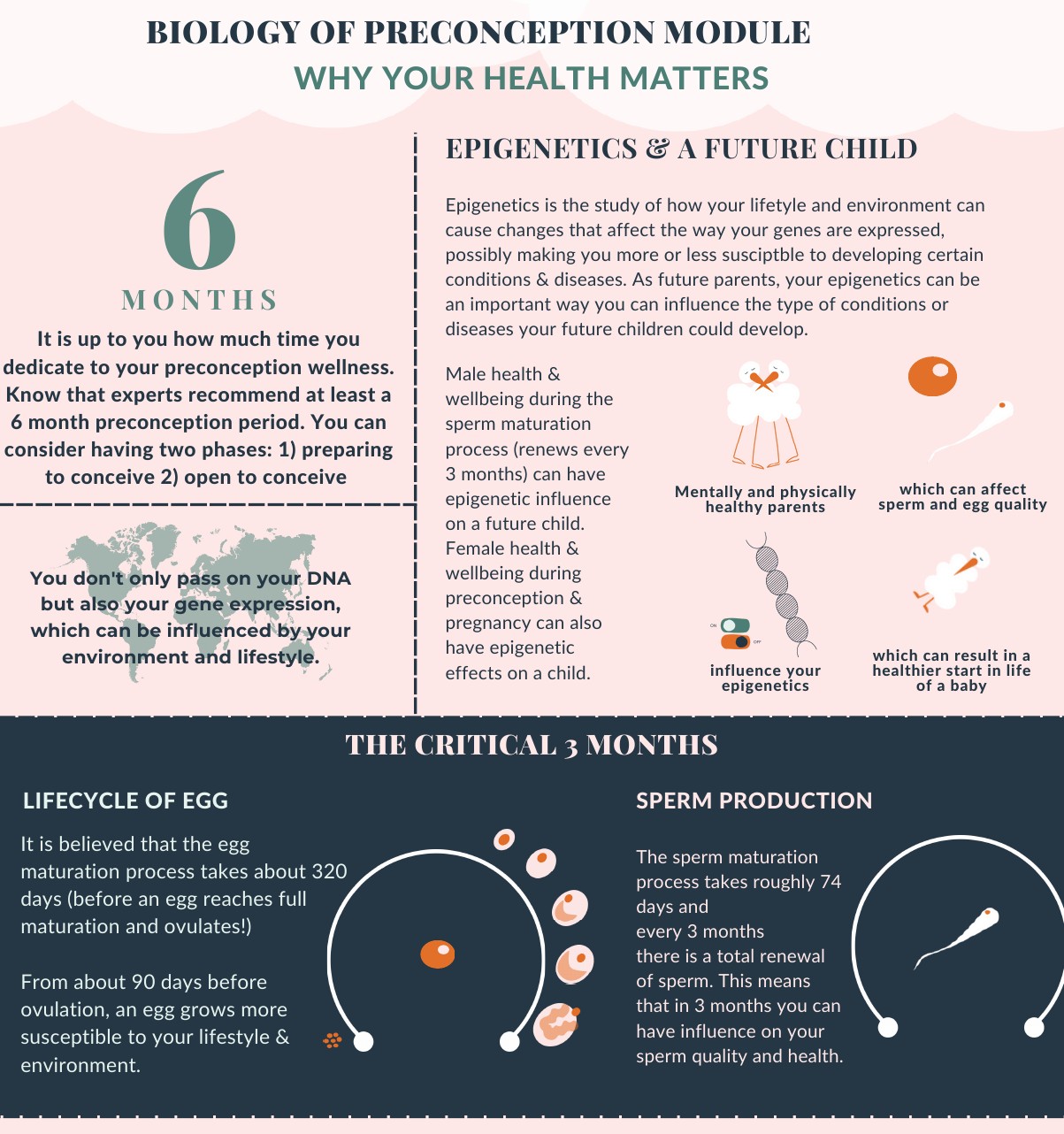
3. Maternal and paternal contributions are different—and both matter
Egg and sperm each contribute genetic information. The egg also supplies most of the early cell's cytoplasm and mitochondria, while sperm brings its own molecular signals alongside DNA. After conception, the health of the person carrying the pregnancy helps shape the uterine and placental environment. These are complementary roles, not identical contributions to every outcome.
Where two partners are involved, this gives shared preparation a biological basis as well as an emotional one. If you are preparing solo or using donor eggs or sperm, the same principle still applies: focus on the health and support within your influence, not on a biological history you cannot change. Our article on paternal preparation explores the often-overlooked sperm side of the conversation.
4. Early pregnancy: why health before conception matters
An embryo's earliest development and the first stages of placental formation begin before many people know they are pregnant. The placenta becomes the interface for oxygen, nutrients and other signals between the pregnant person and the developing baby. Starting pregnancy with existing health needs understood and supported matters because care does not begin with the positive test.
Nutritional status and metabolic and cardiovascular health are part of this foundation. That does not mean more is always better, or that one food prevents a complication. Existing high blood pressure or diabetes, a history of pregnancy complications, and smoking are examples of issues worth discussing before conception. A clinician can help distinguish what needs medical care from what can be supported through everyday routines.
5. Pre-eclampsia, preterm birth and birth weight: be specific about risk
These outcomes are often grouped together in wellness headlines, but they have different causes. Addressing some risk factors can help lower certain risks; it does not follow that a lifestyle programme prevents all three. We also need to separate research linking a factor to an outcome from trials showing that changing the factor changes the outcome.
- Pre-eclampsia involves new high blood pressure in pregnancy with signs of organ or placental dysfunction, usually after 20 weeks. Prior pre-eclampsia, chronic hypertension, diabetes and kidney disease are among the relevant risk factors. Preconception review can identify care needs, but healthy habits cannot guarantee prevention.
- Preterm birth means birth before 37 completed weeks. It can follow spontaneous labour or an early delivery needed for medical reasons. Smoking and some health conditions are modifiable contributors; previous preterm birth and a multiple pregnancy are examples of risks that are not simply changed by lifestyle.
- Low birth weight means less than 2,500 g at birth. It can result from being born early, restricted growth in the womb, or both. Smoking, undernutrition and placental problems can contribute. Low birth weight is not the same as being small for gestational age, which accounts for how far along the pregnancy is.
The evidence for stopping smoking is more direct than a general claim about ‘optimising’ lifestyle: trials of support for smoking cessation during pregnancy show improvements in outcomes including birth weight. That is evidence for a specific intervention in a particular setting, not proof that every preconception habit reduces every pregnancy risk. And smoking itself illustrates the need for precision: it harms pregnancy health even though observational studies sometimes report a lower incidence of pre-eclampsia among smokers.
A complication is not evidence that someone failed to prepare. Biology, previous health, access to care and circumstances beyond personal control all matter.
6. Epigenetics: the way cells use their genetic instructions
Epigenetics describes mechanisms that regulate gene activity without changing the DNA sequence. DNA methylation adds small chemical marks to DNA; histone modifications affect the proteins around which DNA is wrapped. Alongside other systems, these influence which instructions a cell can access. A useful analogy is a library: the books remain, but the reading patterns differ.
Nutrition, metabolic health and environmental exposures can be associated with epigenetic differences in eggs or sperm. However, much epigenetic information is reset during the formation of reproductive cells and again in early embryonic development. Some marks, including genomic imprints at particular stages, are handled differently. It is therefore too simple to say that every habit is passed straight to a future child as a permanent setting.
Animal experiments can test mechanisms under controlled conditions. Human studies often cannot separate parental biology from shared genes, food, income, home environment and later parenting. A change in a sperm marker also does not automatically establish a change in a child's health. Our introduction to epigenetics unpacks these ideas in a more everyday way.
7. Lifelong foundations: metabolic, immune and cardiovascular health
The developmental origins of health and disease—often shortened to DOHaD—studies how environments during early development relate to health later in life. It includes preconception, pregnancy and infancy, not just the months before trying. The idea is that developing systems respond to the conditions around them, with effects that may persist as the child grows.
- Metabolic foundations include how the body regulates energy, glucose and fat storage. Research explores links between early nutrition, parental metabolic health and later susceptibility to metabolic disease.
- Immune foundations concern how developing immune systems respond and learn. Prenatal exposures, infection, nutrition, birth and later microbial environments all contribute; evidence for precise preconception effects in humans is less established.
- Cardiovascular foundations involve the developing heart, blood vessels and blood-pressure regulation. Studies examine how fetal growth and early environments relate to later cardiovascular risk.
Preconception conditions may be one part of those foundations, including through reproductive-cell biology and the health carried into pregnancy. But epigenetics is not the only mechanism, and these findings do not show that a particular routine gives a child lifelong resilience. Later nourishment, relationships, healthcare and social conditions remain important. A beginning can matter without determining the whole story.
8. What to do with the science—without making life smaller
Whether you are planning ahead, actively trying or taking time to reset, you do not need to wait for an ideal version of yourself. These timelines explain why sustained support can matter; they do not tell you to delay conception or treatment. Begin with a small number of useful actions, shaped around your real circumstances.
- Arrange an individual preconception conversation if you have an existing condition, a previous complication or questions about your fertility. Bring both partners' questions where relevant.
- Build regular, satisfying meals around variety: plants, protein, fibre-rich carbohydrates and fats you enjoy. Avoid restrictive ‘fertility diets’ and promises to repair egg quality.
- Seek support to stop smoking if needed. If workplace exposures concern you, ask a qualified occupational-health professional rather than trying to eliminate every household product.
- Choose manageable movement and a repeatable sleep rhythm. These support general wellbeing; they are not tests of readiness or treatments for infertility.
- Share the practical and emotional work with a partner or trusted support person. Pick one change that feels realistic this week, then review it gently.
For a practical overview, try our preconception checklist, or take the free Storka Compass. If you would like structured learning, our nine-week preconception programme brings together ten modules, specialist conversations and practical resources. Its lessons and materials were made by Ingrid, Adrien and the people we worked with—not AI. It offers education and reflection, not fertility treatment or guaranteed outcomes.
General education, not individual medical advice. Speak with a qualified healthcare professional about your circumstances, especially existing conditions, pregnancy risks or difficulty conceiving. Do not delay care to complete a lifestyle plan.
Sources and further reading
- Heller & Clermont (1963) · Spermatogenesis in Man: An Estimate of Its Duration
- Johnson & Varner (1988) · Human epididymal transit time
- Gougeon (1986) · Dynamics of follicular growth in the human: a model from preliminary results
- Stephenson et al. (2018) · Before the beginning: nutrition and lifestyle in the preconception period
- Duckitt & Harrington (2005) · Risk factors for pre-eclampsia: systematic review
- Chamberlain et al. (2017) · Psychosocial interventions for supporting women to stop smoking in pregnancy
- Donkin & Barrès (2018) · Sperm epigenetics and influence of environmental factors
- Hanson & Gluckman (2014) · Early developmental conditioning of later health and disease