Epigenetics: the conversation between generations on your fertility journey

In simple words: epigenetics is how your genes get switched on and off. You cannot change the genes you were born with, but your daily habits—food, sleep, stress, movement and environment—can influence which ones are turned up or down.
The science of epigenetics changed how I thought about the months before pregnancy. It showed me that genes are not a fixed script, while also reminding me that influence is not the same as control.
A library, not a rewritten book
Imagine your genes as a library. The books stay the same, but which pages get read—and how often—can change. Epigenetics is the study of those reading patterns: what changes gene activity without changing the DNA itself.
How do genes get switched on and off?
Think of small sticky notes and dimmer switches on your DNA. Some notes say ‘read this less’, others make a section easier to reach. Scientists call the best-known ones DNA methylation (the sticky notes) and histone modification (how tightly the DNA is wound up, like thread on a spool). The genetic code itself stays exactly the same; what changes is how the cell uses it.
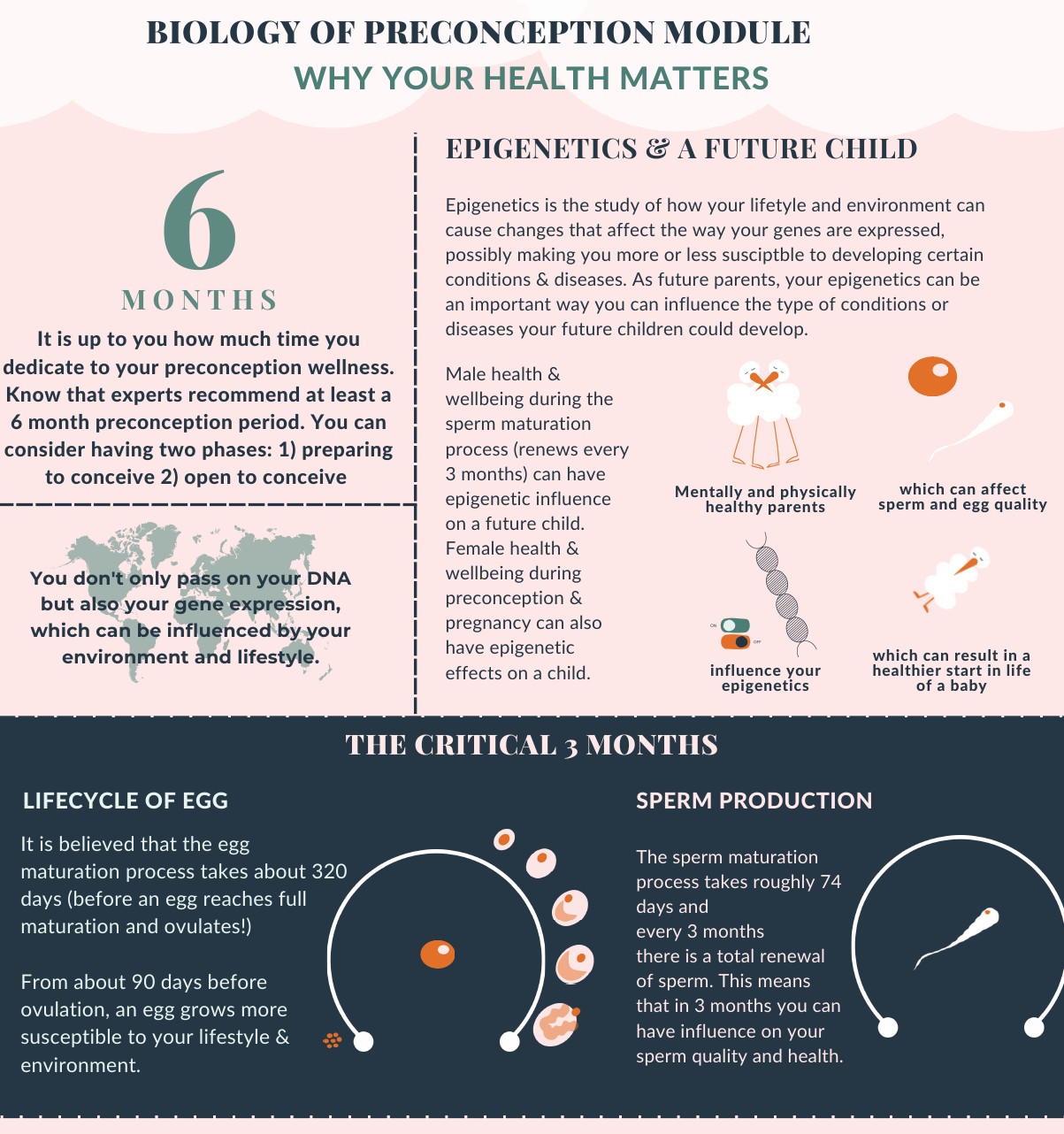
What does that mean for you in practice? The habits you repeat most often are part of the signal your cells receive every day. That is empowering—and also a reason to focus on steady foundations rather than perfect days.
Why does the time before conception matter?
Egg and sperm cells carry more than DNA—they also carry some of these on-and-off settings. Most are wiped clean around fertilisation, like a fresh start, but a few are kept on purpose (scientists call this genomic imprinting). In short: the health of both partners in the months before conception is part of what gets passed on.
This is why scientists are interested in the months before conception. It is a biologically active period for both partners. It does not mean that one meal, one stressful week or one household product ‘programmes’ a future child.
What the research can—and cannot—tell us
Studies can identify associations between factors such as nutrition, smoking, metabolic health, stress or environmental exposure and particular epigenetic patterns. An association is not proof that one factor directly caused a change, nor that the change will produce a specific fertility or health outcome. Human lives contain many overlapping influences, and much of the detailed cause-and-effect research comes from laboratory and animal studies.
Epigenetics describes biological possibility, not personal destiny. It should expand the preconception conversation—not create a new reason for guilt.
Sperm is half of the biological story
Preconception advice is often directed almost entirely at women, yet sperm also carries genetic and epigenetic information. Sperm cells develop continuously over a period of weeks, and researchers are studying how sustained factors in a man's health and environment may be associated with sperm quality and epigenetic patterns. This makes shared preparation biologically relevant, while still avoiding promises that a particular habit will control an outcome.
Five grounded takeaways
- Your DNA sequence is not being rewritten by every daily choice.
- Epigenetic marks help cells regulate which genetic instructions they use.
- Both egg and sperm biology belong in preconception discussions.
- Consistent patterns matter more than a single perfect day.
- Supportive habits can serve your wellbeing even when they cannot guarantee conception or a future outcome.
Lifestyle and self-care before conception
Nutrition, environment, sleep, stress and other experiences can interact with biology. A useful response is to focus on sustainable foundations—varied food, restorative sleep, movement, avoiding smoking, and individual medical care where needed—without trying to micromanage every exposure.
In Module 3, molecular biologist Annie Pettersson, PhD takes this foundation further through the biology of preconception, including why both egg and sperm health belong in the discussion.
The invitation is not to be perfect. It is to become informed and intentional about what is genuinely within your influence.